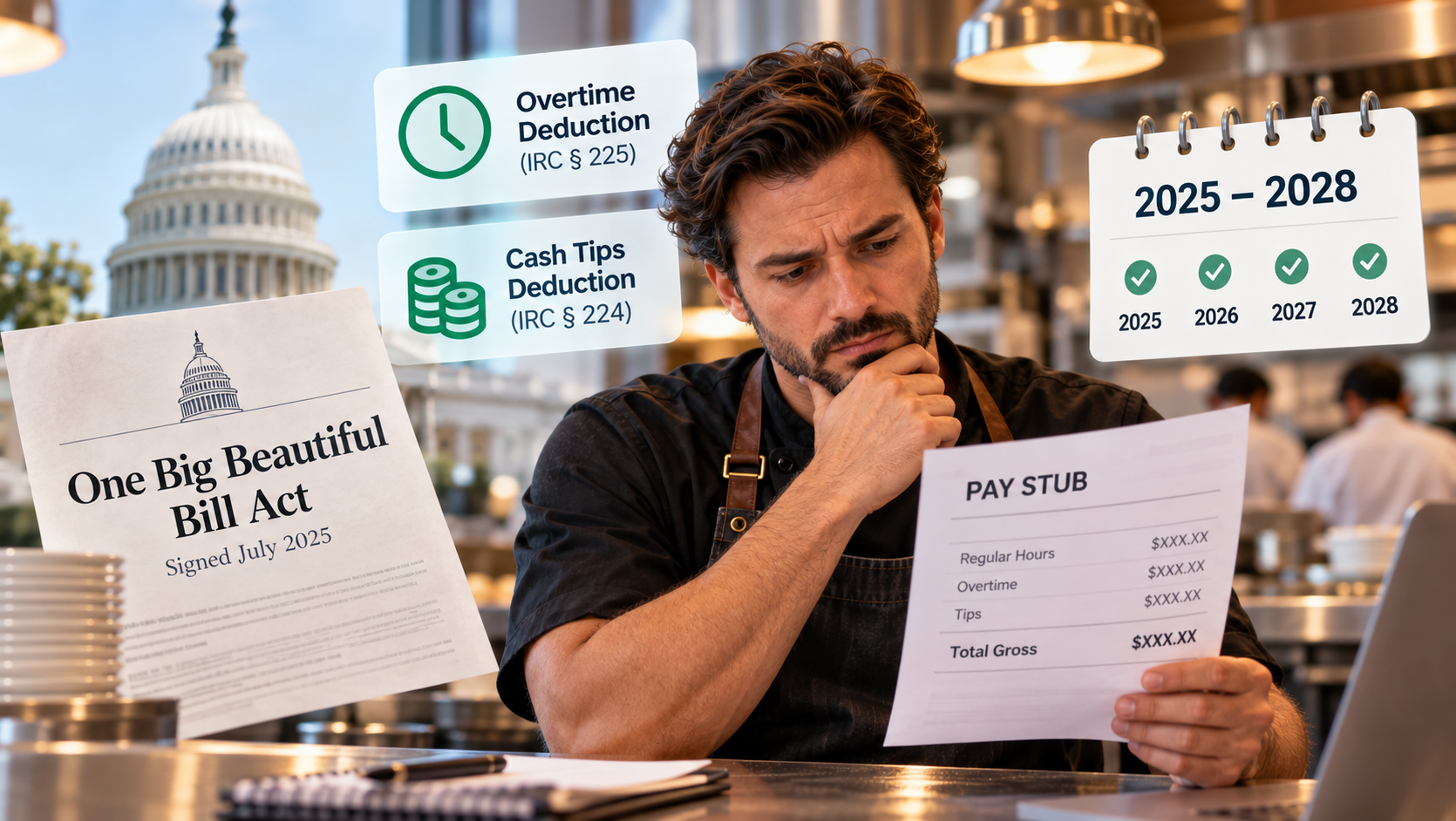

No Tax on Overtime: What Restaurant Operators Must Track, Report, and Say to Their Teams in 2026
By Billy Giordano, Co-Founder, StaffedUp
Former restaurant operator. Built StaffedUp after losing a line cook before a Saturday rush and spending $400/month on Indeed for three months with zero hires. I know what it’s like when your back-of-house team asks you a payroll question you don’t have an answer to.
Last updated: November 2026
The Short Answer for Operators
“No tax on overtime” is a federal income tax deduction for your employees — not a payroll tax exemption and not a change to how you run payroll. What changes in 2026 is your W-2 obligation: you must separately report each employee’s qualified overtime premium in Box 12 using Code TT. Miss it, and your employee loses the deduction — there’s no self-reporting fallback anymore. The 2025 grace period is over. W-2s for 2026 wages are due January 31, 2027, so verify your payroll system now.
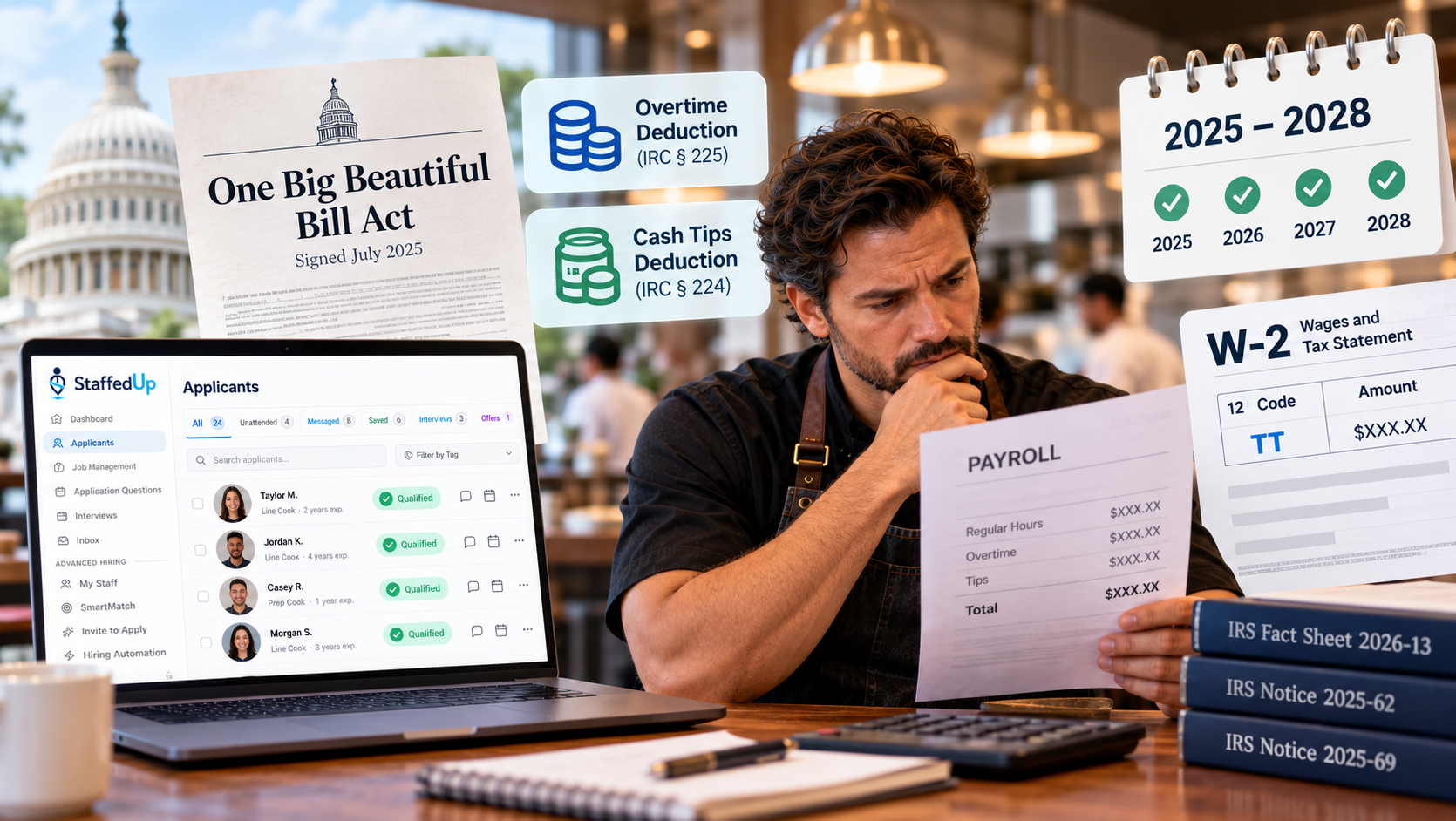
What “No Tax on Overtime” Actually Means for Your Restaurant
When the One Big Beautiful Bill Act passed in July 2025, the shorthand traveling through break rooms — “overtime is tax-free now” — was already inaccurate. What the OBBBA actually created was an above-the-line federal income tax deduction for tax years 2025 through 2028: one for qualified overtime compensation (IRC § 225), one for cash tips (IRC § 224). These deductions live on your employee’s individual federal return. They do not touch payroll.
IRS Fact Sheet 2026-13 is explicit: qualified overtime stays fully subject to standard federal income tax withholding. You may not reduce withholding unless the employee furnishes an updated Form W-4. Social Security, Medicare, and state and local income taxes are unaffected — the deduction is federal only, and state conformity varies widely. When my line cook asked whether he’d stop paying taxes on his overtime, I gave him the honest answer: his paycheck math doesn’t change, but when he files, the federal income tax he paid on that overtime premium may come back to him. That’s the real story — tell your team correctly before they hear a distorted version.
The deduction is capped at $12,500 per year ($25,000 on a joint return), phasing down above $150,000 of modified AGI ($300,000 joint), and it sunsets after 2028 unless Congress extends it.
What Counts as Qualified Overtime — the Premium Only
The statute is specific. Qualified overtime compensation is the amount required under 29 USC § 207 (the FLSA) that is in excess of the employee’s regular rate — the premium half only. A line cook earns $18/hour and works 50 hours in a week. Their FLSA overtime rate is $27/hour for those 10 hours over 40. The Code TT amount is $9/hour × 10 hours = $90 — not $270 (full overtime wages) and not $180 (base-rate portion). Just the premium. If you pay more than the FLSA floor — double-time for a holiday shift — only the one-half portion the FLSA requires counts.
| Scenario | Code TT? | Why |
|---|---|---|
| Non-exempt, 45 hours, 1.5× regular rate | Yes | Required by § 207; the 0.5× premium qualifies |
| Holiday double-time, employee worked 38 hours | No | Voluntary pay; employee did not exceed 40 hours |
| California daily OT (over 8 hrs/day, under 40/week) | No | State-law requirement only; no federal FLSA trigger |
| Double-time, employee worked 45 hours | Partial | Only the 0.5× FLSA premium qualifies; extra excluded |
Salaried exempt employees — your GMs, salaried chefs — generate no Code TT. No FLSA overtime obligation, no Code TT.
The Tipped-Employee OT Wrinkle — Servers, the Tip Credit, and No Double-Dipping
This is the section most payroll blogs skip, and it affects every tipped employee who works more than 40 hours. Under the FLSA (29 USC § 203(m) and § 207), tipped employees can be paid a cash wage as low as $2.13/hour federally, with tips making up the difference. But the FLSA overtime rate is calculated off the full applicable minimum wage — not the cash wage. The tip credit reduces the cash amount paid; it doesn’t change the OT rate base. And per IRS guidance, the same dollar cannot count for both Code TP (tips) and Code TT (OT premium).
| Illustration (federal min. wage, standard tip credit) | Server (tip credit, $2.13 cash) | Line Cook (no tips, $18/hr) |
|---|---|---|
| Regular rate used for OT | $7.25 (full min. wage) | $18.00 |
| OT rate (1.5×) | $10.88/hr | $27.00/hr |
| Qualified OT premium (Code TT) | ~$3.63/hr (0.5× over min. wage) | $9.00/hr |
| Same dollar in both codes? | No — prohibited | N/A |
The honest takeaway: a server who works overtime and earns strong tips qualifies for both deductions — but the Code TT amount is meaningfully smaller than a BOH employee’s, and the no-tax-on-tips deduction is likely the bigger win for your FOH team. Don’t oversell the OT benefit to servers.
State callout: Tip credit amounts vary by state. California, Minnesota, and several others don’t allow a tip credit — the tipped OT base there is the full state minimum wage, often well above $7.25, which changes the Code TT amount significantly. These figures are federal-only illustrations. Verify with your payroll provider and CPA before configuring W-2 reporting. Rules vary by state; nothing here is tax advice.
Your New W-2 Obligation — Box 12 Code TT, and Why 2026 Is Different
For tax year 2026, separate overtime reporting is mandatory. The 2026 W-2 instructions added three Box 12 codes under the OBBBA: TA (contributions to a Trump account), TP (total cash tips), and TT (total qualified overtime compensation). You report the total FLSA-required premium paid during the year, summed across pay periods — even if the employee’s deduction is capped. You report what was paid; the cap is the employee’s to apply on their return. For tipped staff, also confirm Box 14b (the Treasury Tipped Occupation Code) is populating.
2025 was a buffer year. Notice 2025-62 told employers the IRS wouldn’t impose §§ 6721/6722 penalties for failing to separately report qualified overtime, and Notice 2025-69 let employees reconstruct the amount themselves (Methods A through G) when their employer hadn’t coded it. FS-2026-13, issued August 6, 2026, removes all of that. The grace period language is gone, Methods A through G are gone, and there is no transition relief for 2026. Plain translation: if Code TT is blank on a January 2027 W-2, the employee loses the deduction — their only recourse is a corrected W-2c from you.
Penalty exposure runs under IRC §§ 6721–6722 as per-form information-return penalties that escalate the longer a correction waits — from roughly $60 per form for a quick fix up into the hundreds per form if filed late or not at all, and higher still for intentional disregard. Filing with the IRS and furnishing to the employee are separate obligations, so one bad W-2 can produce two penalties. Confirm the current-year amounts with your provider — the operative point is simple: get Code TT right the first time, because fixing it in January is expensive in both money and goodwill.

Five Questions to Ask Your Payroll Provider Before December 31
Most independent operators run Square Payroll, Toast Payroll, Gusto, or a local service tied to their POS. Not all updated their FLSA premium calculation and W-2 coding automatically. Verify in writing before year-end — email creates a paper trail.
- Is your system updated to calculate and separately track Box 12 Code TT for all non-exempt, FLSA-covered employees — FLSA-required OT only, not state-law OT or sub-40-hour holiday pay?
- For tipped employees on the tip credit, do you calculate the OT premium off the full applicable minimum wage — not the $2.13 cash wage? If it’s off the cash wage, every tipped Code TT entry is wrong.
- Do you track tip income separately from OT premium so the same dollars don’t appear in both Code TP and Code TT? This depends on clean POS-to-payroll integration.
- Are Box 14b Treasury Tipped Occupation Codes populating for all tipped employees on our 2026 W-2s? Some systems don’t configure this by default.
- If we find a Code TT error after W-2s issue, how do you generate a W-2c — and what’s the turnaround? Know the recovery path before the January penalty clock starts.
Operators in states without a tip credit (California, Minnesota, and others): question #2 still applies — the OT base is the full state minimum wage, often $16–$17 or higher, which changes the calculation significantly. This checklist isn’t a substitute for your CPA. Ask these questions before December, not in January.
Turn the OT Deduction Into a BOH Hiring Talking Point
Here’s the honest setup: tipped workers benefit more from the OBBBA than overtime workers, because the full tip amount qualifies while only the premium portion of overtime does. That means your back-of-house crew — line cooks, prep, dishwashers — are the ones for whom the OT deduction is most meaningful relative to total pay. They aren’t getting the tip deduction; their OT premium may be the only new line on their federal return. A line cook who regularly works 50 hours earns $9/hour in Code TT on those 10 OT hours — potentially $4,500+ a year in qualified overtime compensation. The National Restaurant Association’s State of the Industry research consistently shows BOH retention tracking against total-compensation signals, and how clearly staff understand their take-home is a turnover lever. If the operator across the street isn’t communicating this, you have a recruiting edge.
Use it without over-promising. At the offer stage, two factual sentences work:
“We pay overtime for all hours over 40, and starting with your 2026 W-2 that overtime premium is separately reported in Box 12, so you can claim the federal tax deduction if you qualify. Talk to a tax professional about your situation — but we want you to know it’s there.”
When you post a line cook role, put your OT structure and total-comp details in the listing. A job description that says so filters for candidates evaluating the whole picture, not just the base rate — and the ATS handles the hiring half while you sort out payroll. Post your first job for $1 and see who applies within 24 hours.

State Taxes, Service Charges, and Evolving Guidance
State taxes don’t move. The federal OT deduction is federal only. Some states conform; many don’t. Operators in California, New York, Illinois, and other high-tax states shouldn’t assume employees benefit at the state level — that’s a question for the employee’s own tax preparer, and worth telling your team so expectations are set right.
Service charges are not tips. An automatic 18% or 20% service fee distributed to staff is likely a service charge under the IRS definition — not a qualified tip for Code TP. If you’ve moved to a service-charge model, confirm with your payroll provider and CPA how it affects W-2 reporting for tipped staff.
The guidance is still evolving. FS-2026-13 superseded the January 2026 FAQ and added rules for 2026 through 2028, but Treasury and the IRS may issue more before January. The deduction expires December 31, 2028 unless Congress extends it — if you’re building it into offer conversations, be clear it’s not permanent law.
Compliance disclaimer: Nothing in this post is tax or legal advice. IRS and Treasury guidance on OBBBA provisions continues to evolve, and state tax treatment varies by state. Verify all decisions with your payroll provider and a qualified tax professional before acting.
You got the compliance part — now hire the team
Post your first job for $1. Sean O. (Irish Pub & Grill, Chicago) replaced a $400/month Indeed spend with a $1 StaffedUp post and had a qualified applicant in 18 hours. If a qualified applicant isn’t in your inbox within 24 hours, you pay nothing — the charge reverses automatically. Under 3 minutes from a phone, no demo, no contract, cancel in-app.
Frequently Asked Questions
Does “no tax on overtime” mean I stop withholding taxes on overtime pay?
No. Withholding is unchanged. The OBBBA created a deduction employees claim on their own federal return — it doesn’t reduce payroll tax, FICA, or your withholding obligation. Per IRS FS-2026-13, you may not reduce withholding unless the employee submits an updated Form W-4. Your payroll process runs exactly as before; your new obligation is the W-2 reporting.
What is W-2 Box 12 Code TT, and when do I start using it?
Code TT captures the total qualified overtime compensation you paid each employee during the year — the FLSA-required premium (the “half” in time-and-a-half), not the full overtime wage. Starting with 2026 wages, this reporting is mandatory, and those W-2s are due to employees by January 31, 2027. The 2025 grace period under Notice 2025-62 does not extend to 2026.
Does the overtime deduction apply to my tipped servers and bartenders?
Yes, but the qualified amount is smaller than for non-tipped employees. A tipped employee’s OT premium is calculated off the full applicable minimum wage, not the $2.13 cash wage, and the no-double-dipping rule means the same dollar can’t qualify for both Code TP and Code TT. Confirm the calculation with your payroll provider; it varies by state minimum wage and tip-credit rules.
What happens if I forget to report Code TT on an employee’s W-2?
The employee loses the deduction entirely. Unlike 2025, there’s no self-reporting option for 2026 wages — if Code TT is blank, their only recourse is a corrected W-2c from you. You also face per-form information-return penalties under IRC §§ 6721–6722 that escalate the longer the correction waits, and filing with the IRS and furnishing to the employee generate separate penalties. Confirm current-year amounts with your provider.
How can StaffedUp help me find BOH employees who weigh total compensation?
Post your first job for $1 at staffedup.com/hire and include your OT structure and total-comp details in the listing. Applicants see that information before they apply — filtering for candidates evaluating the full picture, not just the base rate. If a qualified applicant isn’t in your inbox within 24 hours, you pay nothing — the charge reverses automatically. No setup call, no contract, under three minutes from your phone.
Sources
- IRS Fact Sheet 2026-13 (August 6, 2026) — Qualified Overtime Compensation: reporting and individual deduction. irs.gov/pub/taxpros/fs-2026-13.pdf
- IRS Notice 2025-62 — transition relief for 2025 W-2 overtime reporting. Internal Revenue Bulletin 2025-36.
- IRS Notice 2025-69 — alternative methods (A–G) for employee self-calculation, tax year 2025 only.
- IRS 2026 General Instructions for Forms W-2 and W-3 — Code TT, Code TP, Box 14b. irs.gov/pub/irs-pdf/iw2w3.pdf
- One Big Beautiful Bill Act (enacted July 2025) — IRC § 224 (tips), IRC § 225 (overtime).
- 29 USC § 207 and § 203(m) (FLSA overtime and tip credit) — U.S. Department of Labor, dol.gov/agencies/whd/flsa.
- National Restaurant Association — State of the Industry, back-of-house labor and total compensation.

Hire Smarter, Faster
StaffedUp simplifies hiring for restaurant & hospitality operators. Post your first job for $1.