
Hourly Hiring Software Pricing: 6 Platforms Compared in 2026
By Billy Giordano, Co-Founder, StaffedUp
Former restaurant operator. Built StaffedUp after losing a line cook two hours before a Saturday rush — and spending $400/month on Indeed for three months that produced exactly zero hires.
Last updated: November 2026
Hourly hiring software pricing for restaurant-specific platforms runs roughly $29–$139/month per location for the tools that publish their numbers. Two of the six platforms here — Harri and Workstream — don’t publish pricing at all; you’ll need a demo before seeing a figure, which matters when you’re making a budget decision tonight. StaffedUp starts at $1 for the first job post, then $29/month flat. HigherMe is roughly $80–$99/month per location (third-party sourced — verify directly). Homebase’s hiring features require the Plus tier at $70/month. Breezy HR’s paid plans start at $157/month and were built for office ATS workflows, not shift-based restaurants. The full table is below.
The Pricing Comparison Table: 6 Platforms, Real Numbers
What each platform actually costs, how pricing is structured, whether you can see the number without a sales call, and whether it was built for restaurants or adapted for them.
| Platform | Entry Price (per location/mo) | Full Suite (~20 employees) | Pricing Public? | Built for Restaurants? |
|---|---|---|---|---|
| StaffedUp | $1 first post, then $29/mo | $29/mo flat (unlimited posts) | ✅ | ✅ built by operators |
| HigherMe | ~$80–99/mo* | ~$99–139/mo* | ⚠️ verify | ✅ QSR/franchise |
| Homebase | Free (Basic) / $30 Essentials | $70/mo Plus (hiring); payroll +$39 +$6/employee/run | ✅ | ⚠️ scheduling-first |
| Breezy HR | Free Bootstrap / $157 Startup | $273 Growth; SMS +$41, onboarding +$49 | ✅ | ❌ office ATS |
| Harri | Quote only | ~$875/mo for ~100-employee group† | ❌ demo | ✅ enterprise hospitality |
| Workstream | Quote only | Undisclosed — per-location, per-module | ❌ sales | ✅ QSR franchise |
*HigherMe figures are third-party as of 2026 — verify directly, as some tiers require a contact form. †Harri is a third-party pricing inquiry for a hypothetical ~100-employee business; actual pricing varies by modules, locations, and integrations (not a vendor-published figure). Breezy Growth ($273) + SMS ($41) + onboarding ($49) = $363/month, 33% above the headline. Prices from each vendor’s public pricing page as of September 2026 — verify directly before purchasing.
Pricing Transparency: Who Shows You the Number vs. Who Makes You Book a Demo
Score it 1–5, where 5 means a public pricing page with exact tiers, no sales contact, and a monthly-billing option. StaffedUp (5/5): $1 first post on a public page, $29/mo flat, no demo or contract. Breezy HR (4/5): all four standard tiers published; Pro requires a quote. Homebase (3/5): base tiers published, but payroll add-on costs require calculation and aren’t prominently displayed. HigherMe (2/5): some tier figures appear in third-party sources; the official page may require contact — verify live. Harri and Workstream (1/5): no rate card or per-employee figure published anywhere; every tier routes to a sales contact. To be fair, demo-gating exists for a reason — enterprise software genuinely varies by module, location count, and integration complexity, and Harri and Workstream are built for multi-location operators where a contract of that size warrants implementation support. That’s a legitimate sales motion, not a bait-and-switch. The problem is when you’re a 15-employee independent restaurant that needs to post a job tonight: that sales conversation is a week you don’t have.

What the Entry Price Doesn’t Tell You: Add-Ons, Per-Location Fees, and Feature Gating
Three cost patterns consistently catch operators off guard. Payroll add-ons that dwarf the base subscription: Homebase Plus is $70/month, but Homebase Payroll adds $39/month base plus $6 per employee per run — for a 20-employee restaurant on bi-weekly payroll, that’s 26 runs × $6 × 20 = $3,120 in per-run fees annually plus $468 in base fees, roughly $3,588 in payroll costs before you touch a hiring feature (verify current figures at joinhomebase.com/pricing). Per-location stacking: Homebase, HigherMe, and Workstream all price per location — a second location isn’t discounted, it’s a full additional subscription. Feature gating at lower tiers: Breezy HR’s interview scorecards and eSignatures aren’t in the Startup plan ($157/month); they require Growth ($273/month), a 74% jump to reach features most restaurant GMs consider standard. On StaffedUp, the $29/month flat rate covers unlimited active posts, candidate screening, and SmartMatch scoring with no hiring add-ons; payroll is deliberately out of scope, since StaffedUp is a hiring platform, not an HR suite. See how the StaffedUp ATS works. Four questions to ask any vendor before you sign: what’s the total monthly cost including all add-ons you’ll realistically use for your employee count; does the feature you need live in the base plan or a higher tier; what’s the per-location fee if you open a second location; and what’s the cancellation policy and notice period? (StaffedUp cancellation: 15-day notice before your next bill.)
What Does This Actually Cost a Single-Location Restaurant for 12 Months?
The scenario: single-location full-service restaurant, ~20 employees, 10–15 hires a year, one GM handling hiring, no dedicated HR, budget-conscious but losing time and money to empty seats on the schedule.
| Platform | Year 1 Cost (hiring features) | Notes |
|---|---|---|
| StaffedUp | $1 + ($29 × 11) = $320 | Unlimited posts, screening included |
| Homebase (Plus) | $70 × 12 = $840 | Payroll additional if needed |
| HigherMe | ~$80–99 × 12 = ~$960–$1,188* | Per-location; verify live |
| Breezy HR (Growth) | $273 × 12 = $3,276 | SMS + onboarding add ~$1,080/yr |
| Harri | ~$875 × 12 = ~$10,500† | Third-party reported; actual varies |
| Workstream | Quote only | No estimate without a sales call |
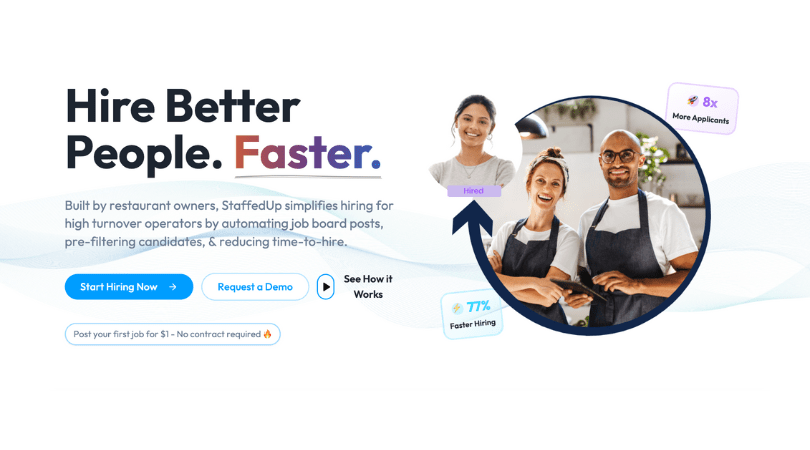
Then there’s the cost of the problem this software solves. One short-staffed Friday at a 60-cover restaurant running $45 average covers produces roughly $540–$810 in turned-away or degraded revenue, plus overtime for the crew compensating — and three weeks of an unfilled line-cook position at that rate exceeds the annual cost of StaffedUp. Replacing one hourly employee runs well over $2,000, landing in the $1,400–$3,400 range per retained hire once attrition is factored in (see our restaurant cost-per-hire breakdown for the full component math). A restaurant doing 10 hires a year faces $14,000–$34,000 in annual replacement cost on that basis — before a single short-staffed service. Across StaffedUp accounts, operators see 8x more applicants, 77% shorter time-to-hire, and 45% decreased turnover. Sean O. at an Irish pub in Chicago spent $400/month on Indeed for three months — $1,200 for zero qualified hires; he posted his first job for $1 and had a qualified applicant in his inbox within 18 hours.
Restaurant-Specific Fit: Built for Shift Hiring vs. Adapted for It
Not all hourly hiring software solves the same problem. Built for restaurants and shift hiring: StaffedUp (founded by operators; distribution and screening built for hourly shift roles; independent to multi-location, 1–50 per site), Harri (deep hospitality operations — tip pooling, demand scheduling, POS integration; for established groups with 100+ employees and HR staff), and HigherMe (QSR and franchise focus; high-volume application flow; best for franchisees with multiple high-turnover units). Scheduling-first, hiring added: Homebase (strong scheduling and time tracking; hiring is a feature layer, good for operators who want both in one tool). Office ATS adapted for hourly: Breezy HR (a capable ATS with clean pipelines and published pricing, but no shift-scheduling integration and not optimized for high-volume hourly — it works for salaried managers or admin roles, less so for line cooks and servers at volume; honest positioning, not a knock). Franchise/enterprise QSR: Workstream (strong text-based candidate communication; pricing built for enterprise franchise agreements, not independent single-location operators). If you’re evaluating pricing for a single independent location, the enterprise sales motions won’t match your timeline.

When Paid Hiring Software Isn’t Worth It Yet
If you’re a single-location restaurant making fewer than 10 hires a year and your current process — free Indeed, job boards, word of mouth, a Facebook post — produces qualified applicants at a pace that keeps you staffed, you probably don’t need paid software yet. Free Homebase is a legitimate option for scheduling-only operators at one location under 20 employees; if hiring is occasional and not the bottleneck, don’t pay to fix a problem you don’t have. Where it flips: BLS JOLTS shows accommodation and food services ran 65.5% annual turnover in 2025 (QSR roles typically run above the sector average), and the NRA’s State of the Restaurant Industry consistently documents staffing as the primary operational challenge for independents. At that pace, every extra week in your hiring cycle compounds into real staffing exposure — and the question isn’t whether hiring software is worth it, it’s whether going without costs more than $29/month. Danielle K. at an independent bar in St. Louis posted Thursday night, had three qualified applicants by Friday morning, and hired for Saturday: one post, 36 hours, one shift covered.
The lowest published price in this comparison — start for $1
Post your first job for $1. Then $29/month flat — unlimited active posts, no hiring add-ons, no demo, no contract, cancel in-app. A qualified applicant in your inbox within 24 hours, or you pay nothing and the charge reverses automatically. Under three minutes from your phone.
Frequently Asked Questions
How much does hourly hiring software cost per month?
For restaurant-specific platforms that publish pricing, roughly $29–$139/month per location. StaffedUp is the lowest at $1 for the first post then $29/month flat; Homebase’s hiring tier (Plus) is $70/month; HigherMe runs roughly $80–$99/month (third-party, verify directly); Breezy HR starts at $157/month and reaches $363 with add-ons. Harri and Workstream don’t publish pricing — expect a demo and a custom quote.
Which hourly hiring platforms make you book a demo to see pricing?
Harri and Workstream both route every tier to a sales contact — no public rate card or per-employee figure. That’s common for enterprise platforms where cost genuinely varies by module, location count, and integration, but it’s friction if you’re a small operator who needs to post a job this week. StaffedUp, Breezy HR, and Homebase all publish pricing openly; HigherMe publishes partially, so verify its current figures directly.
Why is Homebase’s real cost higher than its headline price?
Homebase’s entry tiers are inexpensive (free Basic, $30 Essentials), but hiring features require the Plus tier at $70/month per location, and payroll is a separate add-on at $39/month base plus $6 per employee per payroll run. For a 20-employee restaurant on bi-weekly payroll, payroll alone can run roughly $3,500/year before any hiring feature. The headline number isn’t the number you’ll actually pay if you need hiring and payroll.
Is Breezy HR good for restaurant hiring?
Breezy HR is a capable applicant tracking system with transparent pricing and clean candidate pipelines — but it was built for office and white-collar hiring, not shift-based restaurant roles. It has no shift-scheduling integration and isn’t optimized for high-volume hourly flow. For a restaurant hiring salaried managers or admin staff it works; for line cooks, servers, and bartenders at volume, a restaurant-native platform fits the workflow better.
What’s the cheapest hourly hiring software for a single restaurant?
Among platforms that publish pricing, StaffedUp is the lowest: $1 for the first post, then $29/month flat for unlimited active posts with screening included — about $320 in year one. Free Homebase covers scheduling-only operators but doesn’t include hiring features (those need the $70/month Plus tier). For a single independent location focused on hiring, the flat $29/month with no per-location stacking and no add-ons is the lowest real cost.
How do I try StaffedUp — and what does it cost to start?
$1 for your first job post, then $29/month for unlimited active posts, no contract. Post from your phone in under three minutes — no demo, no setup call. If a qualified applicant isn’t in your inbox within 24 hours, you pay nothing and the charge reverses automatically. “Qualified” means the applicant meets your criteria, is available for your hours, is within radius, and completed the application. Start at staffedup.com/hire.

Sources
- Vendor public pricing pages (September 2026): Homebase and Breezy HR (verifiable public figures); HigherMe (third-party estimates, verify directly); Harri and Workstream (quote-gated, no public rate card).
- U.S. Bureau of Labor Statistics, JOLTS — accommodation and food services annual turnover 65.5% (2025).
- National Restaurant Association, State of the Restaurant Industry — staffing as the primary operational challenge for independents.
- StaffedUp, restaurant cost-per-hire breakdown — component model, $1,400–$3,400 per retained hire.
- StaffedUp platform data: 8x more applicants, 77% shorter time-to-hire, 45% decreased turnover — internal aggregate.

Hire Smarter, Faster
StaffedUp simplifies hiring for restaurant & hospitality operators. Post your first job for $1.