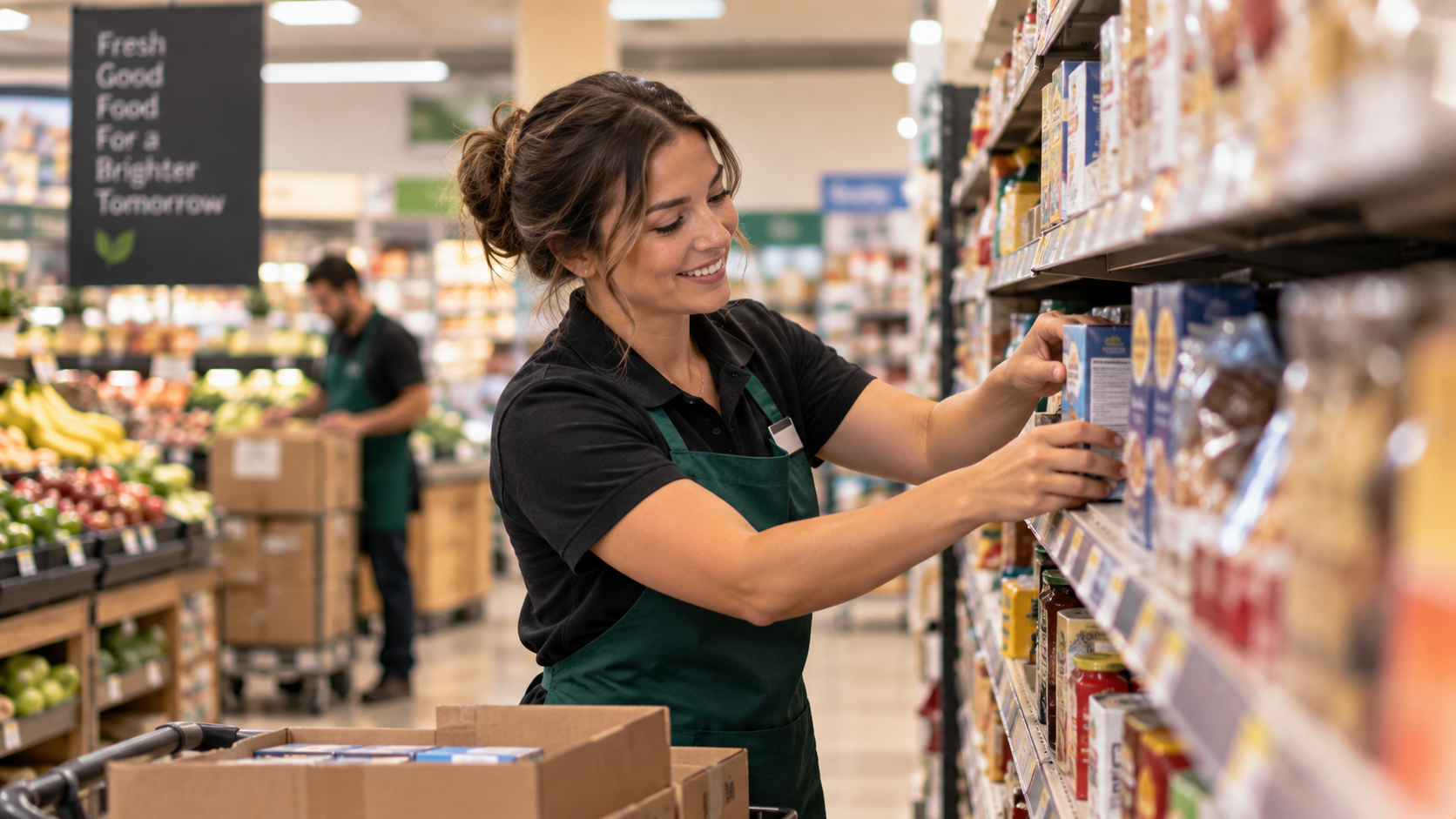

Grocery Store Hiring Software: What Works for Operators in 2026
By Billy Giordano, Co-Founder, StaffedUp
Former restaurant operator. Built StaffedUp after losing a line cook before a Saturday rush and posting “URGENTLY HIRING” on Facebook to zero replies. That same wall — needing someone on the floor now, with no pipeline — is what grocery operators hit every week.
Last updated: September 2026
Grocery store hiring software is an applicant tracking system built for hourly, high-volume, and seasonal frontline roles. It distributes your job post across major job boards, screens out unqualified applicants automatically, and delivers qualified candidates to your inbox without manual review. The right platform also handles compliance details a generic ATS ignores: minor work-permit tracking, food-handler certification timelines, and batch-hire workflows for holiday surges. Operators using StaffedUp see 77% shorter time-to-hire on average. The best platform depends on your size, location count, and whether you’re hiring one cashier or 25 seasonal associates.
What Does Grocery Store Hiring Software Actually Do?
In plain terms: you post one job, the platform distributes it across major job boards, applicants are screened against your criteria, and qualified candidates land in your inbox. It’s the layer between posting chaos and your inbox. Generic ATS tools are built for salaried roles with hiring cycles that take weeks; grocery hiring operates on 48-hour windows, so if your cashier isn’t scheduled by Thursday, you’re short-staffed Saturday. Most grocery operators cobble together Indeed, a paper application, and a phone call from whoever’s at the front desk — a gamble on which manager is working, not a process. An applicant tracking system built for hourly staff gives you a repeatable process that doesn’t depend on the individual. Retail posts among the highest separation rates of any industry (BLS JOLTS), and grocery runs higher still — so you’re hiring continuously, and one-off-hiring software doesn’t hold up.
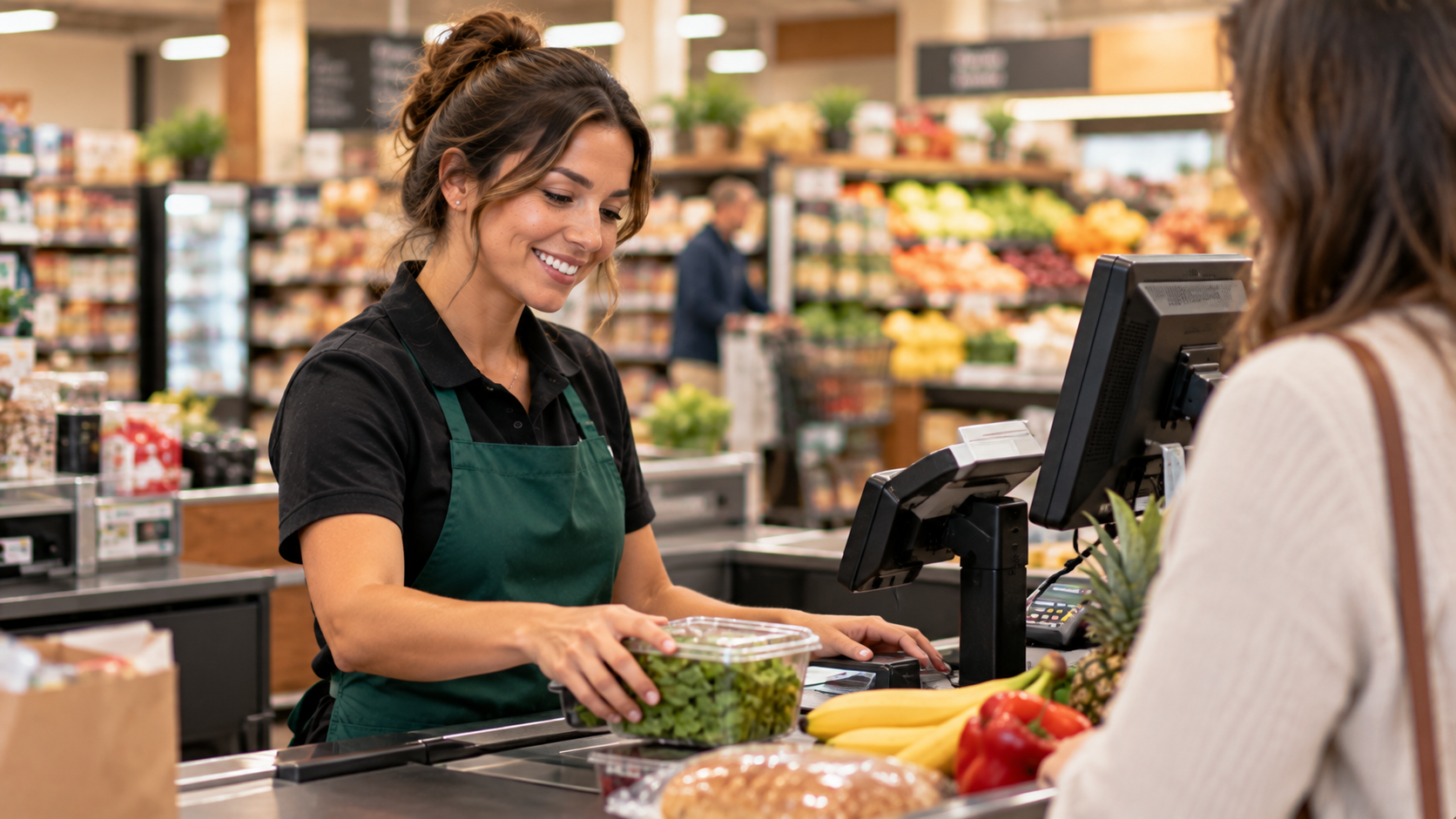
One honest note: job boards like Indeed have massive reach, and some operators do fine posting there directly for rare, one-off hires. The case for an ATS layer is volume, screening, and multi-location consistency — if you hire two people a year and your process works, a full ATS might be more than you need.
The Minor Work-Permit Problem: Hiring 16-Year-Olds Across Multiple Locations
Employment law varies by state — check with your state labor department or counsel. This section covers the federal FLSA baseline and is not legal advice.
Grocery stores are among the most common employers of minor-age workers — bagging, restocking, and running a register are real entry-level roles for 14–17-year-olds, especially weekends and evenings. But hiring minors without a compliance workflow is one of the most expensive mistakes a multi-location operator can make. Whether minors need a work permit depends on the state; about 40 states require an employment certificate or “working papers” before starting, typically signed by the employer, the minor, and a parent or guardian.
The hazardous-occupations rules are the sharper edge. Under the FLSA, workers under 18 may not load, operate, or unload cardboard balers and compactors, or drive forklifts. DOL Fact Sheet #38 also prohibits under-18 workers from operating or cleaning power-driven meat slicers and grinders — regardless of what’s being processed, so slicing cheese or vegetables on the same equipment is still prohibited. The multi-location failure mode is real: Store #3’s closing manager doesn’t know the 17-year-old stocker can’t run the cardboard compactor. FLSA violations can result in civil penalties of more than $15,000 per minor per violation, adjusted annually for inflation, with additional state penalties possible. Good hiring software should flag minor-age applicants, prompt for permit verification before scheduling, and keep a permit-on-file record per hire — not standard in most generic ATS tools, so verify it directly.
| State | Work Permit Required? | Notes |
|---|---|---|
| California | Yes (under 18) | Permit from school district; employer keeps on file |
| Texas | No state permit | Federal FLSA hours and hazard rules still apply |
| Florida | Yes (under 18) | ID/verification via school or county |
| Illinois | Yes | Employment certificate required |
| Washington | Yes (employer permit) | Employer must have and post a Minor Work Permit per worksite |
| New York | Yes | Employment certificate from school |
Requirements vary by state and change. Verify with your state labor department or counsel before hiring minors. Not legal advice. Source: DOL Fact Sheet #38 and the DOL prohibited-occupations list.
Food-Handler Certification Timelines: Closing the Compliance Gap
Certification rules vary by state and often by county — always verify with your local health department.
Food-handler requirements are set at the state level and vary dramatically: some require certification before the first shift, others leave it to counties or have no statewide requirement. The timing gap is the operational problem — hire a stocker in Texas and you have roughly 30 days to certify them; hire in Washington and you have 14. What operators do wrong is hire, schedule, and assume the cert gets handled, while the training packet sits in a break-room drawer. Your hiring software should track cert status per hire alongside the offer letter, flag uncertified hires before they hit the schedule, and send reminders as deadlines approach. Most don’t do this natively, so ask explicitly.
| State | Deadline After Hire | Notes |
|---|---|---|
| Washington / Utah | 14 days | WA card issued by county health department |
| California | 30 days | ANSI-accredited courses accepted statewide |
| Texas | 30 days | Use a DSHS-approved provider (confirm current rule) |
| Illinois | 30 days (Chicago) | City-level requirement; statewide rules vary |
| Florida | 60 days | No statewide mandate; many counties require it |
Requirements change and are often set at the county or city level. Verify with your local health department before scheduling any new hire in a food-handling role. Not legal advice.
Batch and Seasonal Hiring: Running a Two-Week Surge Without Losing Control
When you need 10–25 people in a two-week window — Thanksgiving, back-to-school — normal hiring fails at batch scale. Triaging 60+ applications per store and phone-screening 30 people to find eight who can work weekends isn’t something one GM can do while running a store. Marisol V. (Seasonal Bar & Grill, Pensacola) ran exactly this through StaffedUp — 60 applications narrowed by screening to five who actually wanted to work. Volume isn’t the problem; unfiltered volume is. Two levers make a surge manageable: batch interview slots (group 3–4 candidates the same morning, same four questions at every store) and QR-code scan-to-apply cards at the register and front door — your best seasonal applicants are already in your store, so make it easy to apply before they leave. Across StaffedUp postings, operators see 8x more applicants and 77% shorter time-to-hire; the lever is screening, not reach.
Multi-Location Consistency: Why Store #4 Can’t Hire Differently Than Store #1
You have four stores, two GMs you trust and two you don’t. When you’re not watching, Store #4 is posting on Facebook and hiring whoever shows up. That’s not a management problem — it’s a process problem: every GM has a different version of “how we hire here,” and you can’t benchmark across stores if the inputs differ. Consistent hiring software gives you one dashboard with location-level control, the same operator-defined screening criteria everywhere, and thresholds no GM can drift from — the Store #4 GM still makes the final call, but from the same filtered pool as Store #1. Ryan French (MDP Restaurant Group, 7 locations) described StaffedUp’s impact as making hiring seamless across all locations — a consistent baseline your whole operation can be held to. Operators using StaffedUp see 45% decreased turnover.
What to Look For — and How the Options Compare
In priority order, a grocery operator needs: single-post distribution to major and niche boards; operator-defined screening with a human override (not black-box AI scoring); mobile posting and review; minor-applicant flagging and food-handler cert tracking; a centralized multi-location dashboard with location-level control; built-in interview scheduling; onboarding that starts before the first shift; and transparent, month-to-month pricing. How the named options compare: Workstream is a strong full-platform option for multi-location operators who want hiring, scheduling, and payroll in one system — pricing requires a consultation. Homebase is scheduling-and-time-tracking first, with hiring secondary — a fit if scheduling is your primary problem. Sprockets led with personality scoring and is now part of Humanly following its 2025 acquisition, so verify the current feature set and pricing directly. StaffedUp focuses on the hiring layer — distribution, operator-defined screening, qualified applicants to your inbox — at $1 for the first post, then $29/month, no contract.
Does Grocery Hiring Software Pay for Itself?
Replacing one hourly grocery employee runs into the thousands of dollars once you count recruiting, training, onboarding, and lost productivity. At $29/month — $348 a year — the software pays for itself if it prevents even one bad hire, and for a multi-location operator turning over dozens of associates a year, even a small reduction in turnover covers it many times over. Where it probably isn’t worth it: one location, low turnover, hiring twice a year with no friction. Even then, the $1 first post is worth trying — you’ll know within 24 hours whether it delivers, and if it doesn’t, you pay nothing.

StaffedUp for Grocery and C-Store: What It Does, and Who It’s For
You post one job in under three minutes from your phone, the platform distributes it to major job boards, operator-defined screening filters out mass-applies and applicants who can’t work your hours, and qualified candidates land in your inbox — no contract, no demo. These named outcomes come from hospitality operators on the platform: Danielle K. (Independent Bar, St. Louis) posted Thursday night and had three qualified applicants by Friday morning, hired for Saturday; Sean O. (Irish Pub & Grill, Chicago) spent $400/month on Indeed for three months with zero hires, then got a qualified applicant 18 hours after his $1 StaffedUp post; Ryan French runs seamless hiring across seven locations. For a grocery operator, the $1 first post is how you test it in your own vertical. What StaffedUp doesn’t do: it’s not a full-suite HR platform — no native payroll, scheduling, or benefits; if you need those in one login, evaluate Workstream first. It’s right for grocery and c-store operators with 1–20 locations who have a recurring hiring problem and aren’t ready to commit to an enterprise platform before proving the approach works.
Post your first grocery or c-store job for $1. Live in under three minutes from your phone — no contract, no setup call, no desktop. If you don’t have a qualified applicant — meeting your criteria, available for your hours, within your radius, with a completed application — in your inbox within 24 hours, you pay nothing and the charge reverses automatically. After the first post, it’s $29/month for unlimited active posts, cancel anytime in-app.
Frequently Asked Questions
What is the best hiring software for grocery stores in 2026?
It depends on store size and what you’re solving for. For payroll, scheduling, and hiring in one platform, Workstream is worth evaluating. For faster, higher-quality applicant flow without a full platform overhaul, StaffedUp distributes to major job boards, screens automatically, and delivers qualified candidates to your inbox — starting at $1. Key features to require: operator-defined screening, minor-applicant flagging, food-handler cert tracking, and mobile posting.
What are the work-permit rules for hiring minors in a grocery store?
Requirements depend on the state — about 40 states require minors to obtain an employment certificate before starting. Federally, workers under 18 are prohibited from operating cardboard balers and compactors, driving forklifts, and operating or cleaning power-driven meat slicers and grinders — regardless of what’s being processed. FLSA violations can result in civil penalties of more than $15,000 per minor per violation, adjusted annually. Verify your state’s rules with your state labor department before hiring. This is not legal advice.
What is the average employee turnover rate for grocery stores?
Grocery has one of the highest turnover rates of any U.S. industry — industry estimates have placed annual grocery turnover well above 60% in recent years, though figures vary by source. Retail broadly posts among the highest separation rates of any sector per BLS JOLTS, and grocery runs higher than the retail average. The practical implication: you are always hiring.
Does hiring software track food-handler certification status for grocery employees?
Some platforms do, but many standard ATS tools don’t include cert tracking as a native feature, so ask explicitly. Common deadlines after hire include 14 days (WA, UT), 30 days (CA, IL, OR, TX), and 60 days (FL). Good grocery hiring software should track cert status per hire, send reminders before deadlines, and flag uncertified employees before they’re scheduled in food-handling roles. Check your local health department for current requirements.
How do I try StaffedUp for my grocery or c-store operation?
Post your first job for $1 at staffedup.com/hire. No contract, no setup call, no desktop — post from your phone in under three minutes. If you don’t receive a qualified applicant in your inbox within 24 hours, you pay nothing — $0 for the month, charge reversed automatically. A qualified applicant meets your operator-defined criteria: right availability, right location, completed application. After the first post, it’s $29/month with unlimited active posts and easy in-app cancellation.
Sources
- U.S. Bureau of Labor Statistics, Job Openings and Labor Turnover Survey (JOLTS) — retail among the highest-separation-rate industries.
- U.S. Department of Labor, Wage and Hour Division, Fact Sheet #38: Child Labor in Grocery Stores under the FLSA.
- U.S. Department of Labor, WHD, Prohibited Occupations for Minors, and Child Labor Bulletin 101.
- State health department food-handler rules (CA CDPH, TX DSHS, WA DOH, UT, IL DPH, FL DOH) — verify current requirements locally.
- StaffedUp platform data: 8x more applicants, 77% shorter time-to-hire, 45% decreased turnover — internal aggregate across operators.

Hire Smarter, Faster
StaffedUp simplifies hiring for restaurant & hospitality operators. Post your first job for $1.